Anti-Cheat Systems Explained: BattlEye vs EAC vs Vanguard 2026
If you have ever bought a private cheat and got banned within a week, the answer is almost always the same: anti-cheat caught you. Modern anti-cheat systems have evolved into sophisticated kernel-level monitoring tools that scan your hardware, your processes, your behavior, and even your browser tabs for suspicious activity. Understanding how they work is the first step to choosing cheats that survive long-term.
The four dominant anti-cheat systems in 2026 are BattlEye, Easy Anti-Cheat (EAC), Vanguard, and ACE (Anti-Cheat Expert). Each has different architecture, different detection methods, and different levels of aggressiveness. BattlEye protects Tarkov, DayZ, R6S, PUBG, and Arma. EAC is used by Squad, Sea of Thieves, Apex Legends, and Fortnite. Vanguard is the kernel-level monster from Riot that protects Valorant and League of Legends, widely considered the hardest consumer anti-cheat to bypass. ACE is Tencent’s kernel-level system, increasingly common in Chinese-developed titles like Delta Force, Arena Breakout Infinite, and Honor of Kings.
This guide explains how each anti-cheat works at a technical level, what they actually scan for, why some games are easier to cheat in than others, and how cheat developers stay undetected against each system. Whether you are choosing which game to cheat in, evaluating cheat providers, or just curious about how anti-cheat technology works, this is your complete reference.
Quick navigation:
- What Is Anti-Cheat and Why Games Use It
- BattlEye Explained (Tarkov, DayZ, R6S, PUBG, Arma)
- Easy Anti-Cheat Explained (Squad, Sea of Thieves, Apex, Fortnite)
- Vanguard Explained (Valorant, League of Legends)
- ACE Explained (Delta Force, Arena Breakout Infinite)
- Detection Methods Compared Across All Four
- Which Games Are Easiest vs Hardest to Cheat In
- How Cheat Developers Stay Undetected
What Is Anti-Cheat and Why Games Use It
Anti-cheat software is a system designed to detect and prevent cheating in online multiplayer games. Modern anti-cheat goes far beyond simple file scanning, operating at kernel level (Ring 0) with deep system access to monitor for cheat signatures, behavioral anomalies, hardware fingerprints, and process injection attempts.
Why Games Need Anti-Cheat
- Competitive integrity: Cheating ruins ranked progression and PvP balance
- Player retention: Cheaters drive away legit players, causing revenue loss
- Esports credibility: Pro scenes require cheat-free environments
- Reduced toxicity: Less cheating means fewer rage-quits and reports
- Anti-RMT (Real Money Trading): Cheaters often farm currency for resale
- Trust signal: Strong anti-cheat is a marketing point for games
The Three Anti-Cheat Tiers
- Tier 1 (Kernel-level): Vanguard, BattlEye, EAC, ACE — deepest access, hardest to bypass
- Tier 2 (User-mode): VAC (Valve), older proprietary systems — softer detection
- Tier 3 (Server-side only): Some competitive games rely mainly on server analysis
What Anti-Cheat Looks For
- Known cheat signatures in memory (signature scanning)
- DLL injection into the game process
- External processes reading game memory
- Suspicious driver behavior
- Behavioral anomalies (impossible aim accuracy, perfect tracking)
- Hardware fingerprints matching banned databases
- Tampered game files or modified executables
- Virtual machine detection (cheats often run in VMs to hide)
BattlEye Anti-Cheat Explained
BattlEye is one of the oldest and most widely-used anti-cheat systems in the industry, founded in 2004 and acquired by Belgian software company BE Services. It powers some of the most demanding multiplayer games in existence: Escape from Tarkov, DayZ, Arma series, Rainbow Six Siege, PUBG, Fortnite, and Destiny 2.
How BattlEye Works
- Kernel-level driver: Loads at boot with deep system access
- Memory scanning: Continuously scans game memory for cheat signatures
- Process monitoring: Tracks all processes that interact with the game
- Hardware fingerprinting: Collects motherboard, disk, MAC, TPM identifiers
- Server-side analysis: Sends behavioral data to BattlEye servers for ML detection
- Update cycles: Patches deployed multiple times per week
- Cross-game database: Banned hardware shared across all BattlEye games
BattlEye Strengths
- Mature codebase with 20+ years of development
- Strong cross-game ban database (banned in Tarkov = often banned in DayZ)
- Aggressive HWID enforcement
- Active manual review team for player reports
- Regular ban waves remove cheaters in batches
BattlEye Weaknesses
- Slower update cycle compared to Vanguard
- Memory scanning is the primary detection (kernel exploits can bypass)
- Less aggressive behavioral analysis than EAC
- Patches sometimes take days to deploy after detection events
Games Using BattlEye
- Escape from Tarkov
- DayZ
- Arma Reforger
- Rainbow Six Siege
- PUBG
- Fortnite (paired with EAC)
- Destiny 2
Easy Anti-Cheat (EAC) Explained
Easy Anti-Cheat (EAC) is a kernel-level anti-cheat developed by Kamu, acquired by Epic Games in 2018. EAC powers many of the largest multiplayer games in the industry: Squad, Sea of Thieves, Apex Legends, Fortnite (alongside BattlEye), Rust, Dead by Daylight, and dozens of others. EAC is known for its layered detection approach combining signature scanning, behavioral analysis, and aggressive driver monitoring.
How EAC Works
- Kernel driver: Loads at boot with kernel-level privileges
- Behavioral fingerprinting: Tracks how processes interact with game memory
- Driver verification: Validates all loaded drivers against trusted database
- Anti-tamper layer: Encrypted code paths that detect modification
- Heuristic analysis: Identifies suspicious patterns even without signatures
- Cloud-based detection: Suspicious data uploaded for ML-based classification
- Frequent updates: Patches deployed weekly or more often
EAC Strengths
- Strong heuristic detection (catches cheats without exact signatures)
- Aggressive behavioral analysis
- Cross-game protection (Epic Games ecosystem-wide)
- Excellent driver verification (catches signed cheat drivers)
- Regular ban waves combined with continuous monitoring
EAC Weaknesses
- Higher false-positive rate than BattlEye (innocent players occasionally banned)
- Behavioral detection sometimes triggers on legitimate weird gameplay
- Less aggressive HWID enforcement than BattlEye
- Performance overhead higher than BattlEye on lower-end systems
Games Using EAC
- Squad
- Sea of Thieves
- Apex Legends
- Fortnite
- Rust
- Dead by Daylight
- The Finals
- Marathon
- Hundreds of other titles
Vanguard Explained (The Hardest Anti-Cheat)
Vanguard is Riot Games’ proprietary kernel-level anti-cheat, deployed in 2020 alongside Valorant’s launch. In 2024-2025, Riot rolled out Vanguard to League of Legends as well, replacing the legacy Riot anti-cheat. Vanguard is widely considered the most aggressive consumer anti-cheat ever deployed at scale, with kernel-level access running 24/7 from boot, regardless of whether you are actively playing.
How Vanguard Works
- Boot-time activation: Loads with Windows boot, not just when game launches
- Always-on monitoring: Runs in background even when game is closed
- TPM 2.0 requirement: Mandatory on Windows 11, validates hardware identity
- Driver whitelist: Blocks all unsigned/suspicious drivers system-wide
- Cryptographic verification: Hardware identifiers cryptographically signed
- Behavioral ML models: Server-side machine learning for anomaly detection
- Real-time response: Bans deployed within minutes of confirmed detection
Vanguard Strengths
- Hardest consumer anti-cheat to bypass — extremely difficult for cheat developers
- Boot-level access means cheats cannot easily hide from it
- TPM integration makes HWID spoofing extremely complex
- Almost zero successful public cheats for Valorant since launch
- Massive resources from Riot to maintain detection edge
- Cross-game database (Valorant + LoL ban means both blocked)
Vanguard Weaknesses (User Concerns)
- Privacy concerns: kernel-level always-on access criticized by community
- Performance impact higher than BattlEye/EAC on low-end systems
- Conflicts with some legitimate apps (VPNs, certain peripherals)
- Boot-time loading means PC has to restart after Vanguard updates
- Cannot be uninstalled without removing Riot games
Games Using Vanguard
ACE Explained (Tencent’s Anti-Cheat Expert)
ACE (Anti-Cheat Expert) is Tencent’s proprietary kernel-level anti-cheat, developed by the Chinese tech conglomerate that owns Riot Games (Valorant) and dozens of major Chinese gaming studios. Originally launched in 2005 as an antibot for Free Fantasy Online, ACE has evolved into one of the most widely-deployed anti-cheats in the Asian gaming market. In 2024-2025, ACE became increasingly common in Western markets through Tencent-published titles, most notably Delta Force, Arena Breakout Infinite, and Honor of Kings.
How ACE Works
- Kernel driver: Loads at game launch with kernel-level (Ring 0) privileges
- ACE-BASE.sys: Core driver responsible for memory scanning and process monitoring
- Real-time process monitoring: Detects and terminates suspicious processes mid-game
- Memory pattern matching: Scans for cheat signatures with ML-assisted detection
- Hardware fingerprinting: Collects motherboard, disk, MAC, CPU identifiers
- Behavioral analysis: Server-side ML models trained on Tencent’s massive Chinese gaming dataset
- 99.99% claimed accuracy: Tencent advertises high detection rates for mainstream cheats
- Persistent installation: ACE service remains on system even after game uninstall (controversial)
ACE Strengths
- Massive ML training dataset from Tencent’s billions of gaming sessions
- Tight integration with Tencent’s gaming ecosystem (cross-game ban database)
- Aggressive against mainstream public cheats (high detection rates)
- Real-time game termination on cheat detection
- Specialized for Asian-market cheating patterns (huge market knowledge)
- Continuously updated by Tencent’s substantial security team
ACE Weaknesses (User Concerns)
- Privacy concerns: kernel-level access from Chinese company creates trust issues in Western markets
- Service persistence after uninstall criticized as “spyware-like” behavior
- Conflicts with other kernel anti-cheats (especially EAC) reported by users
- Performance overhead noticeable on lower-end systems
- Less mature against Western private cheat developers compared to BattlEye/EAC
- Documentation in English limited (Tencent prioritizes Chinese market)
Games Using ACE
- Delta Force (kernel-level since 2024 launch)
- Arena Breakout Infinite (specialized variant with TPM integration)
- Honor of Kings
- Game for Peace (Chinese PUBG)
- Other Tencent and Level Infinite published titles
ACE vs Western Anti-Cheats
- vs BattlEye: ACE is more aggressive in real-time detection but less mature against private cheats
- vs EAC: Similar kernel-level approach, ACE has stronger ML but less behavioral heuristics
- vs Vanguard: Both kernel-level, but ACE does NOT load at boot (Vanguard does), making ACE slightly easier to bypass
- For cheat developers: ACE-protected games like Delta Force are workable for private cheats with proper HWID protection
Anti-Cheat Architecture Comparison
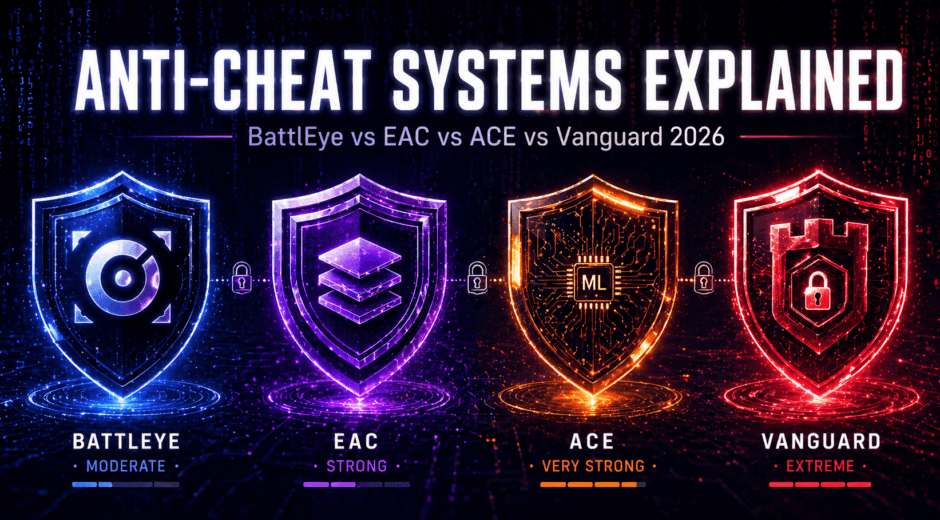
The four major anti-cheat systems differ significantly in how they approach detection. Below is a visual comparison of their architecture, monitoring scope, and detection aggressiveness.
Detection Methods Compared
While all four anti-cheats use kernel-level access, their detection methodologies differ significantly. Understanding these differences helps explain why some games have far more cheaters than others, despite similar player bases.
Signature Detection
Anti-cheat scans game memory for known cheat code patterns. Public cheats with widespread distribution get detected within days because their signatures are easy to identify. Private cheats with small user bases stay undetected because their unique signatures never get added to detection databases.
Behavioral Fingerprinting
Modern anti-cheat tracks how processes interact with the game. Legitimate processes have predictable behaviors. Cheats often hook game functions, read memory in patterns, or modify rendering pipelines in ways that look suspicious. EAC and Vanguard excel here.
HWID Fingerprinting
Anti-cheat collects motherboard, disk, MAC, TPM, and CPU identifiers to create a unique hardware fingerprint. Once a fingerprint is banned, it persists across all accounts on that PC. BattlEye is most aggressive with HWID enforcement, Vanguard combines it with TPM cryptographic verification.
Statistical Analysis
Server-side anti-cheat tracks player statistics looking for anomalies: impossible aim accuracy, perfect tracking through walls, suspicious win rates, headshot percentages outside human possibility. Statistical bans require more evidence but catch sophisticated cheaters that evade memory scanning.
Driver Whitelist
Vanguard pioneered driver whitelisting at scale: only signed, trusted drivers can load. Many cheat developers use signed drivers to gain kernel access. Vanguard blocks even legitimate-looking drivers if they have any known vulnerabilities. EAC implements similar but less aggressive driver verification.
Live Behavioral ML
The newest detection method uses machine learning models trained on cheater vs legitimate player data. Suspicious patterns trigger automatic review or instant bans. Vanguard leads here with real-time response (bans within minutes), while BattlEye and EAC use slower batch processing.
Which Games Are Easiest to Cheat In
Not all games protected by the same anti-cheat are equally easy or hard to cheat in. Factors like cheat developer interest, manual review intensity, behavioral monitoring depth, and reporting systems vary significantly per game.
Easiest Games to Cheat (in 2026)
- Counter-Strike 2: VAC is the weakest mainstream anti-cheat, mostly account bans
- FiveM: Server-side anti-cheat, varies by server, custom solutions exist
- Rust: EAC but enforcement varies, Trusted Rank system imperfect
- Tarkov: BattlEye + Battlestate proprietary, but private cheats stay alive
Moderate Difficulty
- Apex Legends: EAC + Anti-Cheat, ML-based but workable for private cheats
- Squad: EAC, smaller player base means less anti-cheat focus
- Sea of Thieves: EAC, server-side checks but cheats persist
- Fortnite: BattlEye + EAC double-stack, harder than single-AC games
- Rainbow Six Siege: BattlEye + Ubisoft proprietary, frequent ban waves
- Delta Force: ACE kernel-level, manageable for private cheats with HWID protection
Hardest Games to Cheat
- League of Legends: Vanguard kernel-level, almost no successful public cheats
- Valorant: Vanguard + Riot ML detection, TPM cryptographic verification
- Arena Breakout Infinite: ACE with specialized TPM integration, requires dedicated ABI Spoofer
Browse our full game lineup at the shop page for products available on each title.
How Cheat Developers Stay Undetected
Quality private cheat development is a constant cat-and-mouse game with anti-cheat systems. Understanding how cheat developers stay ahead helps explain why private cheats with small user bases survive far longer than public cheats with thousands of users.
Technical Strategies
- Code privacy: Never share source code with public cheats or other developers
- Custom signatures: Each cheat has unique code patterns, no shared cheat-engine logic
- Driver development: Custom kernel drivers signed with trusted certificates
- Hardware-aware code: Cheats adapt behavior based on system fingerprint
- Anti-debugging: Detect when anti-cheat tries to analyze the cheat
- Encrypted modules: Cheat code only decrypts at runtime, hidden from static analysis
- Frequent updates: Patches deployed within hours of detection events
Operational Strategies
- Small user bases: Limit subscribers to keep cheat below detection thresholds
- Vetting system: Verify users before granting access (reduces snitches)
- HWID-locked loaders: Cheat tied to specific hardware to prevent leaks
- Discord communities: Direct communication for rapid update deployment
- Detection telemetry: Real-time reports from users when cheat starts failing
- Status pages: Public dashboards showing cheat health (transparency builds trust)
Why MadChad Stays Undetected
- Operating since 2019 through every major anti-cheat update
- Hand-picked private cheat partnerships, not public reseller
- Multi-game coverage with specialized solutions per anti-cheat type
- Built-in HWID Spoofers on premium products
- Multi-game HWID Spoofers for additional protection
- Active 24/7 Discord with detection alerts
- Transparent Status page
🎯 Want cheats that survive anti-cheat updates?
Browse trusted cheats →Anti-Cheat Future: What to Expect in 2026-2027
Anti-cheat technology evolves rapidly. Several trends are reshaping how anti-cheat will work in the next 2-3 years, with significant implications for cheat developers and players alike.
Trends to Watch
- TPM 2.0 mandatory: More games will require Windows 11 + TPM (following Vanguard’s lead)
- ML-driven detection: Behavioral analysis becoming primary detection method
- Cloud-based scanning: Less client-side scanning, more server-side analysis
- Cross-game ban databases: Cheating in one game affects all games on same anti-cheat
- Hardware-rooted trust: Cryptographic verification at hardware level
- VM detection improvement: Cheats running in virtual machines harder to hide
- Anti-cheat consolidation: Smaller anti-cheats getting acquired or shut down
Implications for Cheaters
- Free public cheats becoming rapidly obsolete
- Quality private cheats becoming relatively more valuable
- HWID Spoofers becoming essential, not optional
- VM-based cheating viable only for shortest periods
- Behavioral discipline more important than software quality
- Cheat development getting harder, prices increasing
Final Thoughts on Anti-Cheat
Understanding anti-cheat is the foundation of choosing cheats that actually work. The three major systems — BattlEye, EAC, and Vanguard — each have distinct architectures and detection methodologies that determine how easy or hard a game is to cheat in.
Key takeaways:
- Vanguard is hardest: Kernel-level boot-time access makes Valorant/LoL almost cheat-proof for public solutions
- BattlEye + EAC are workable: Private cheats with small user bases survive long-term
- VAC is weakest: CS2 and Dota 2 have softest enforcement
- Behavior matters as much as software: Even private cheats get banned if user is reckless
- HWID protection is essential: All major anti-cheat track hardware identifiers
For cheats that survive anti-cheat updates across all three major systems, browse our hand-picked lineup at the shop page or check the HWID Spoofers category for protection layers.
🛡️ Ready for cheats that beat anti-cheat?
Browse all 32 game cheats →Anti-Cheat Systems — Frequently Asked Questions
Which anti-cheat is the hardest to bypass?
Vanguard from Riot Games is widely considered the hardest consumer anti-cheat to bypass in 2026. Its kernel-level driver loads at Windows boot (not just at game launch), runs always-on monitoring even when the game is closed, requires TPM 2.0 for cryptographic hardware verification, and uses a strict driver whitelist that blocks unsigned or vulnerable drivers system-wide. The combination of these factors means very few public cheats exist for Valorant since launch, and League of Legends saw a massive drop in cheating after Vanguard rollout in 2024-2025. ACE (Tencent) is also kernel-level with strong ML detection, ranking just below Vanguard in difficulty especially in Arena Breakout Infinite where it has TPM integration. BattlEye and EAC are more bypassable, particularly for private cheats with small user bases.
Does anti-cheat run when the game is closed?
It depends on the anti-cheat system. BattlEye loads when the game launches and unloads when the game closes, so it does not monitor your PC outside game sessions. EAC behaves similarly, loading at game launch. Vanguard is the exception — it loads at Windows boot and runs always-on, monitoring your system 24/7 regardless of whether you are playing. This is why Vanguard generates the most privacy concerns in the gaming community. If you only play games protected by BattlEye or EAC, anti-cheat is not running on your system between sessions.
Can anti-cheat see my browser tabs or other apps?
Yes, kernel-level anti-cheat (BattlEye, EAC, Vanguard) has the technical capability to read any process running on your system, including browsers, Discord, or any other applications. However, in practice, these anti-cheats focus on identifying cheating-related processes, not surveilling user activity. Reputable anti-cheat companies have strict policies about what they collect and how it is processed, but the kernel-level access remains a privacy concern for some users. Vanguard generates the most discussion because of its always-on nature, but BattlEye and EAC have similar capabilities while running.
What is the difference between signature-based and heuristic detection?
Signature-based detection looks for known cheat code patterns in memory. The anti-cheat maintains a database of cheat signatures (similar to antivirus signatures), and any code matching those patterns gets flagged. This works well against public cheats with widespread distribution but fails against private cheats with unique code. Heuristic detection looks for suspicious behaviors and patterns rather than specific signatures. For example, if a process is reading game memory at impossible speeds or hooking specific game functions in suspicious ways, heuristic detection flags it even without a known signature. EAC and Vanguard rely heavily on heuristics, while BattlEye uses signatures more.
Why do private cheats stay undetected longer than public ones?
Private cheats have small user bases (typically 50-500 active users), which keeps their unique code signatures below the detection thresholds anti-cheat companies prioritize. Public cheats have thousands of users, so anti-cheat companies invest significant resources to identify and ban them quickly. Additionally, private cheat developers can deploy patches within hours when issues arise, while public cheats require larger update infrastructure. The economics work in private cheats’ favor: small user base = less attention from anti-cheat = longer undetected lifetimes. This is why MadChad focuses on private cheat partnerships rather than reselling public solutions.
Can I bypass Vanguard with a HWID Spoofer?
Vanguard is uniquely difficult to bypass with HWID Spoofers because of its TPM 2.0 cryptographic verification. Most consumer HWID Spoofers do not handle TPM spoofing at the cryptographic level required to fool Vanguard. Our standalone Gouda HWID Spoofer DOES support League of Legends (which uses Vanguard), but does NOT support Valorant. The Valorant Vanguard implementation has additional cryptographic checks beyond what is in the LoL implementation. For Vanguard-protected Valorant specifically, hardware-level spoofing or hardware replacement remain the primary recovery options. Browse our HWID Spoofers category for compatible options.
Will anti-cheat cause performance issues on my PC?
Modern anti-cheat is optimized for minimal performance impact, typically 1-3% FPS drop, which is imperceptible during gameplay on modern hardware (Nvidia RTX, AMD Radeon RX 6000/7000, Intel Arc). However, the impact varies by anti-cheat: BattlEye is generally lightest, EAC has moderate overhead due to behavioral monitoring, and Vanguard has the highest impact because of always-on operation. On low-end systems (older CPUs, limited RAM), Vanguard can cause noticeable slowdowns, especially during boot. If you experience FPS drops with a specific game, the anti-cheat is rarely the primary cause — game optimization and graphics settings matter more.
Are anti-cheat systems safe? Can they steal my data?
Major anti-cheat systems (BattlEye, EAC, Vanguard) are developed by reputable companies (BE Services, Epic Games, Riot Games) with established privacy policies. They have access to your system at kernel level, but their stated purpose is cheat detection, not data harvesting. Independent security researchers have analyzed these systems and found no evidence of malicious data collection beyond what is needed for their function. However, kernel-level access is inherently powerful, so users should ensure they only install anti-cheat from official sources (game installers from official platforms like Steam, Epic, or Riot launcher). Avoid downloading anti-cheat installers from unofficial sites.